Push-Back Rack
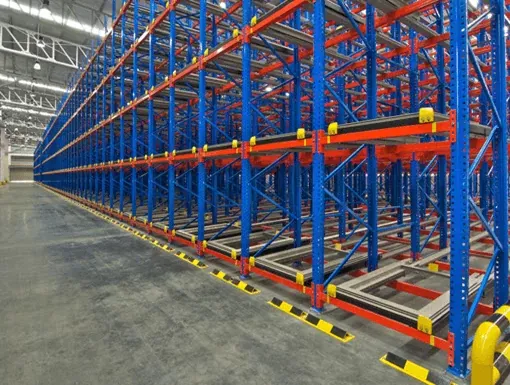
Push-back rack is a deep-lane storage system using nested carts on inclined rails, allowing 2–6 pallets per lane from a single working aisle. ApexBeam push-back racks carry 500–1,500 kg per pallet at heights up to 10 m, delivering higher density than selective racking with faster cycle times than drive-in systems because the forklift never enters the rack structure.
How It Works
Each push-back lane contains a series of nested carts that ride on slightly inclined rails. When a forklift places a pallet at the lane face, it pushes the existing carts and their loads deeper into the lane. On retrieval, gravity pulls the remaining carts forward as each pallet is removed — the next pallet automatically presents itself at the pick face. The forklift operator works entirely from the aisle, never driving into the rack.
This is the key advantage over drive-in rack: because the truck stays outside the structure, cycle times are faster and rack damage risk is lower. The trade-off is lane depth — push-back typically runs 2–6 positions deep versus drive-in's 2–10, since each additional cart adds friction and weight to the push sequence. Push-back operates LIFO per lane, meaning the last pallet loaded is the first retrieved. If your operation requires strict FIFO rotation, gravity flow rack uses braked roller lanes instead of carts to guarantee first-in-first-out flow.
Compared to selective pallet racking, push-back sacrifices instant access to every pallet in exchange for significantly higher storage density — fewer aisles mean more pallet positions per square metre. It occupies a practical middle ground between selective accessibility and drive-in density, making it well-suited for medium-turnover batch stock where multiple SKUs each hold several pallets.
Performance Specifications
| Parameter | Range |
|---|---|
| Load per pallet | 500 – 1,500 kg |
| Lane depth | 2 – 6 pallets deep |
| Rotation | LIFO per lane |
| System height | Up to 10 m |
| Cart type | Nested carts / roller rails |
| Equipment | Counterbalance / reach trucks |
Specifications are standard configuration ranges for preliminary selection; final values are confirmed by engineered calculation and drawings for each project.
Typical Applications
- Medium-turnover batch stock — multiple SKUs with 2–6 pallets each, where LIFO rotation is acceptable
- Cool stores and chillers — denser storage than selective racking without the slow cycles of drive-in; see cold storage racking
- Buffer lanes beside production — staging finished goods or raw materials in compact deep-lane blocks; see food & beverage racking
- 3PL cross-dock facilities — temporary high-density holding for inbound/outbound consolidation; see 3PL logistics racking
Design & Compliance
Every ApexBeam push-back rack project is calculated by our in-house structural team to the code set that applies at your site:
- EN 15512 (Europe) and ANSI/MH16.1 (Americas) for structural design; EN 15620 for tolerances and clearances
- Seismic design to EN 16681 / FEM 10.2.08 with localized dynamic analysis where required
- Our adjustable pallet racking is independently attested to EN 15512:2020+A1:2022 by UDEM (Cert. M.2023.206.C82720, valid to 13 March 2028)
- Steel: mill test certificates traceable per coil batch; standard grades Q235B, Q235D, Q355B and Q355D, with Q460C for high-load applications
- Beam deflection is held to the L/300 serviceability limit; load-notice signage ships with every installation
Related Guides
- The Ultimate Guide to Pallet Racking — all 14 system types, selection logic and code requirements in one page
- Selective vs Drive-In Racking — understand where push-back sits on the density-selectivity spectrum
- Warehouse Racking Cost Guide — cost comparison of push-back vs. drive-in vs. shuttle systems
Compare Your Options
- Selective vs Drive-In Racking — push-back bridges the gap: choose it when you need more density than selective but faster cycles than drive-in
- Pallet Shuttle vs Drive-In Racking — choose shuttle rack when lane depth exceeds 6 positions or you need FIFO/LIFO switching per lane
Related Products
- Drive-In Rack — deeper lanes (up to 10 positions) for bulk LIFO storage, but slower cycles
- Gravity Flow Rack — strict FIFO on braked roller lanes for perishable and dated goods
- Shuttle Rack — semi-automated deep-lane storage with remote-controlled carts for higher throughput
- Selective Pallet Racking — 100% direct access for mixed-SKU operations requiring instant selectivity
- Mobile Rack — highest floor-space efficiency with motorized carriages and full selectivity on demand
- VNA Racking — narrow-aisle selective racking for high-bay density with 100% access
FAQ
How does push-back rack differ from drive-in rack?
In push-back systems, the forklift stays in the aisle and pushes nested carts into the lane. In drive-in systems, the forklift drives into the rack structure itself. Push-back delivers faster cycle times and lower rack damage risk, but typically maxes out at 6 positions deep versus drive-in's 10. Choose push-back when throughput speed matters more than maximum lane depth.
Is push-back rack always LIFO?
Yes. Each push-back lane operates on a last-in, first-out basis because the most recently loaded pallet sits at the pick face. If your products require strict first-in, first-out rotation — for example, perishables with expiry dates — consider gravity flow rack or shuttle rack configured for FIFO.
What maintenance do the nested carts require?
Nested carts run on steel rails with minimal moving parts. Periodic inspection of wheel bearings, rail alignment and cart nesting surfaces is recommended. Unlike motorized systems, there are no batteries, motors or electronics to maintain. We provide a maintenance schedule with every installation.
Can push-back rack handle mixed pallet sizes?
Push-back lanes work best with uniform pallet dimensions within each lane, since the carts are sized to specific pallet footprints. Mixed sizes in the same lane can cause jamming or misalignment. If your SKU mix includes varied pallet sizes, assign each size to dedicated lanes or consider selective pallet racking for those positions.
What information do you need to quote a push-back rack project?
Warehouse drawings, pallet size and weight, number of SKUs per lane, desired lane depth, and forklift type. From that we produce a layout drawing and load calculation; standard products typically ship 20–30 days after order confirmation.
Request a Layout & Quote
Send us your floor plan, SKU list, pallet weights and dimensions, clear height, and desired lane depth. Our structural team returns a free layout drawing with a load calculation — no obligation.
- Email: sales@njapexbeam.com
- Phone / WhatsApp: +86 185 1251 6598
Request an Engineered Layout & Quote
Send your floor plan, pallet dimensions and weights, clear height and SKU profile. Our structural team returns a free layout drawing with a load calculation within 24 hours.